Two graders, a growing curriculum, and no room left to add hands.
The Last Mile brings coding, project management, and skilled trades education into carceral environments. As the program grew to cover more courses and more subjects, the team of two graders faced a backlog approaching ten thousand submissions, a volume the traditional model of every submission read and scored by a person was structurally incapable of keeping up with. Growth also meant asking specialized subject-matter experts to grade further outside their core expertise than before, since new courses were arriving faster than new specialist graders could be hired and trained.
TDG's read on the problem: adding more graders would have been bailing water out of a sinking ship. TLM didn't need more hands. It needed a new approach, one that let existing graders scale the rote work while freeing them up to help students in the ways that really matter, like coaching and mentoring.
A three-month build, compressed into a weekend.
This was scoped as a three-month build. The severity of the backlog didn't allow for that timeline, so TDG compressed the plan into a single weekend and shipped a working MVP, built and deployed while the crisis was still active rather than after it had passed.
A grading system built around judgment, not just automation.
Adding more graders would have been bailing water out of a sinking ship. TLM didn't need more hands. It needed a new approach to the problem.
Built into the tools TLM already runs.
The MVP TDG shipped over that first weekend is running today as a stopgap while TLM stands up its own infrastructure. The next phase, already designed, connects the platform directly to Canvas. Submissions sync into a queue automatically and match to the right question by ID, with anything that doesn't match flagged once for a manual link the system remembers from then on. Once a grade is finalized, it writes the score and feedback straight into Canvas SpeedGrader and posts a summary to the corresponding GitLab work item, so grading plugs directly into the systems TLM's ops team already uses instead of becoming a separate tool they have to check on its own.
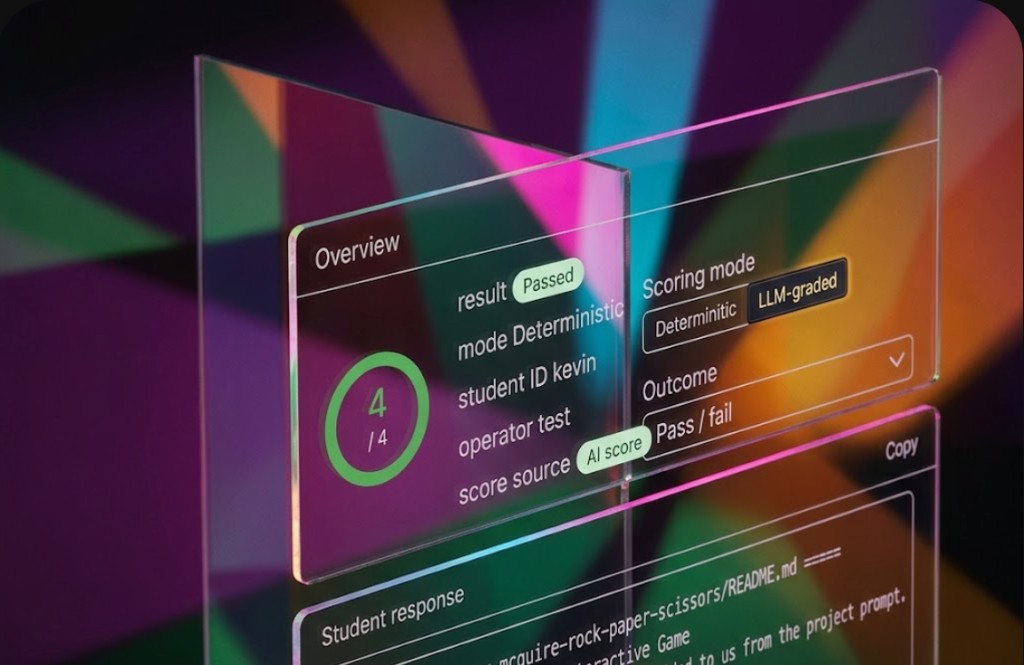
Deterministic & LLM-Graded Modes
Both modes live and in active use as TLM's stopgap grading system.
Calibration Banking
Filling and regenerating automatically from every graded submission across the difficult middle bands.
Full Audit Trail
Recorded for every finalized grade, including operator, model, and timestamp.
Canvas Sync & SpeedGrader / GitLab Posting
Auto-matching and Finalize & Post to SpeedGrader and GitLab, ready to build as TLM migrates onto its own servers.
Explore More Transformations
See how we've helped other mission-driven organizations achieve breakthrough results.