The problem wasn't the technology. It was earning the trust to use it.
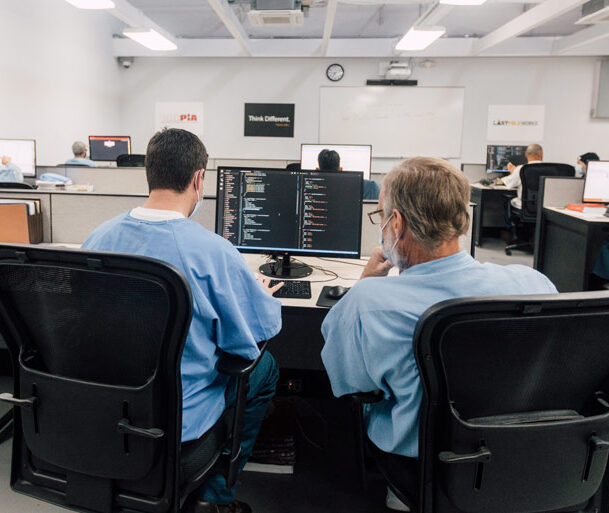
The Last Mile runs award-winning technology education programs inside correctional facilities across the United States. When they decided to add AI literacy to their curriculum, they ran into a problem no one had solved.
Any platform hoping to bring modern, intelligent tools into a prison classroom has to do more than solve a technical problem. It has to earn institutional trust, and that means transparency, auditability, and documented proof that every precaution is being taken.
The security challenge had three distinct layers. First: create an impenetrable barrier between the student and the model. An LLM with even a strong system prompt is still vulnerable to hallucination and drift, and a single failure in a correctional setting ends the program. Second: even a perfectly secure system isn't enough without full transparency. DOCs need to see the record, not just trust the result. Third: if the platform was going to scale across an entire curriculum, security couldn't live inside each simulator. It had to be centralized: one place to control, one place to audit, one architecture that every future simulator could inherit.
What TLM needed wasn't a safer wrapper around an LLM. They needed a centralized platform that could prove its own safety, and once that platform existed, it unlocked something much bigger: the ability to bring the entire digital workplace into the classroom for the first time.
Centralized control. Intelligent feedback. Infinite curriculum.
TDG built the architecture from first principles, designing a system whose security properties come from its structure, not from trusting any single component to behave correctly. Once the secure brain was in place, the curriculum opportunity became clear: any workplace tool could be simulated through the same pipeline, with the same intelligent, rubric-scored feedback.
Someone incarcerated even twelve months ago will be coming home to a world radically transformed by AI. This platform exists so that transformation isn't a blindside.
A pilot at San Quentin. A platform for everything that comes next.
The first cohort launches at San Quentin in May 2026: 11 students working through a full AI literacy curriculum on a platform that gives them real access to frontier models, real rubric-scored feedback, and real workplace tools. A second cohort follows in Indiana in June.
The simulators look exactly like the software students will encounter on the job. The Gmail simulator scores email responses against professional rubrics and sends the student back to try again until they pass. The Prompt Lab teaches students to write effective AI prompts and scores their work against explicit criteria. Every simulator runs through the same secure, auditable brain.
Someone incarcerated even twelve months ago will be coming home to a world radically transformed by AI, where the tools that define modern hiring, modern communication, and modern work have all shifted. This platform exists so that transformation isn't a blindside.
Simulators at Launch
A full AI literacy curriculum deployed across 20 purpose-built learning environments, including email, prompt labs, and AI literacy modules, all running through a single secure backend with intelligent, rubric-scored feedback.
San Quentin Pilot
First cohort of 11 students. The first AI literacy program delivered inside a correctional facility with real frontier model access, intelligent assessment, and a full compliance record.
Structural Security
Triple-layer sanitization built from first principles for environments where a single compliance failure ends the program. Security lives in the architecture, not in model behavior.
Built to Last
TDG funded the build and handed TLM a complete platform: repos, simulators, build process, and trained internal team. The investment was in the sector. The asset belongs to the mission.
Explore More Transformations
See how we've helped other mission-driven organizations achieve breakthrough results.